|
First published: September 23, 2025
Last updated: February 11, 2026
On February 12, Taisho 10 (1921), the Imperial Japanese authorities cracked down on Omoto on charges of lese-majesty - which was a groundless accusation - arresting Onisaburo and other senior members and destroying shrines within Omoto's holy sanctuary. This unlawful religious persecution was later known as the "First Omoto Incident."
 The authorities were overseeing the destruction of Omoto's brand-new shrine atop Mount Hongu within the group's sanctuary in October, Taisho 10 (1921).  Omoto's brand-new shrine atop Mount Hongu within the group's sanctuary was brutally destroyed by the authorities in October, Taisho 10 (1921).
"The Twin Peach-Boys" (Onisaburo and another person) in Mongolia in May, Taisho 13 (1924)
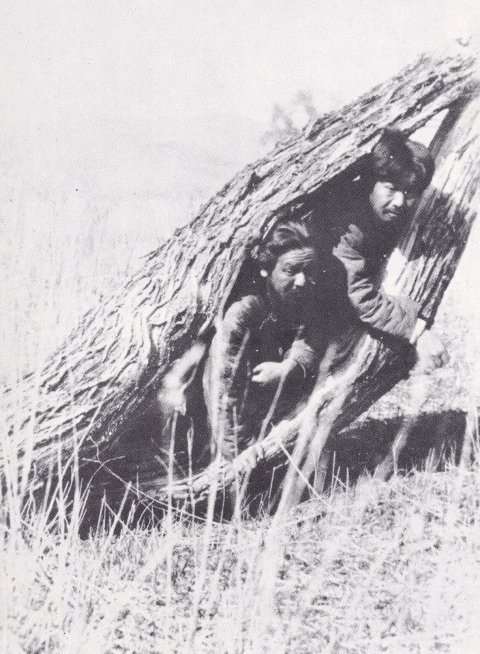 "The Twin Peach-Boys" (Upper: Onisaburo) in Mongolia
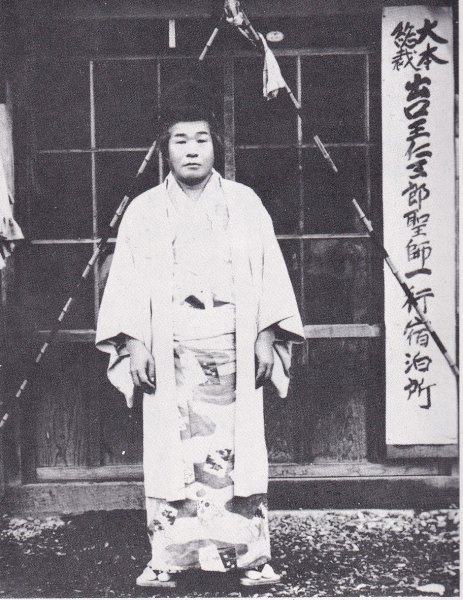
Onisaburo and his entourage doing missionary work in Tochigi about 100 km north of Tokyo in Showa 3 (1928).
Onisaburo doing missionary work in Hokkaido in August, Showa 3 (1928).
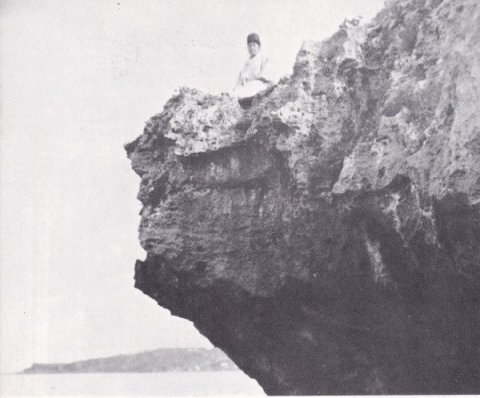
Onisaburo worshipping local kami at Naminoue Shrine in Naha, Okinawa in
Showa 3 (1928).
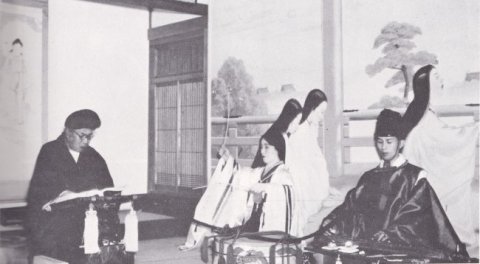
Onisaburo reciting 31-syllable Japanese poems dedicated to the first Poem Festival in Kameoka, Kyoto in Showa 10 (1935)
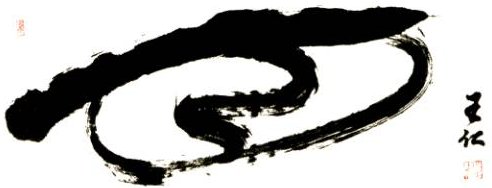
Onisaburo's calligraphy "The Moon"
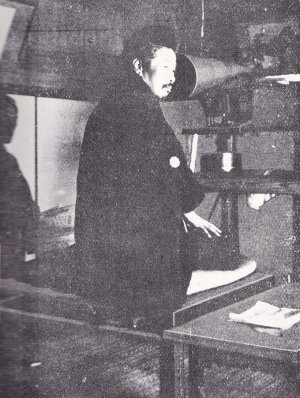
Onisaburo recording his oral reading of the Reikai Monogatari in Taisho 11 (1922)
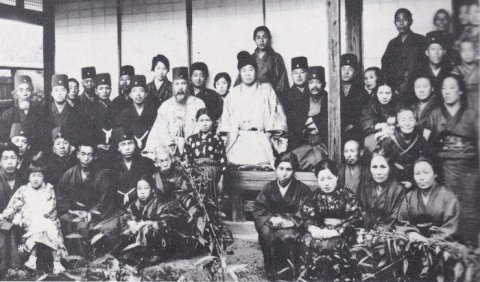
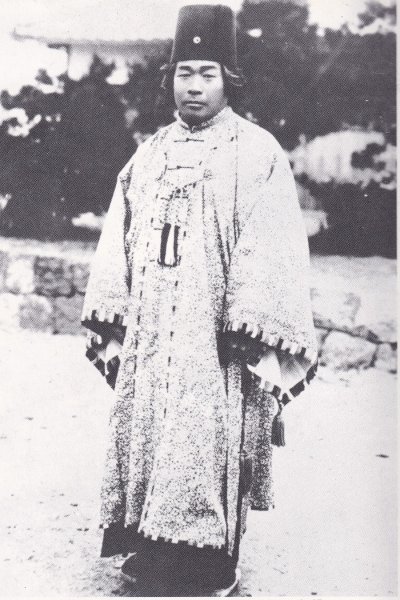
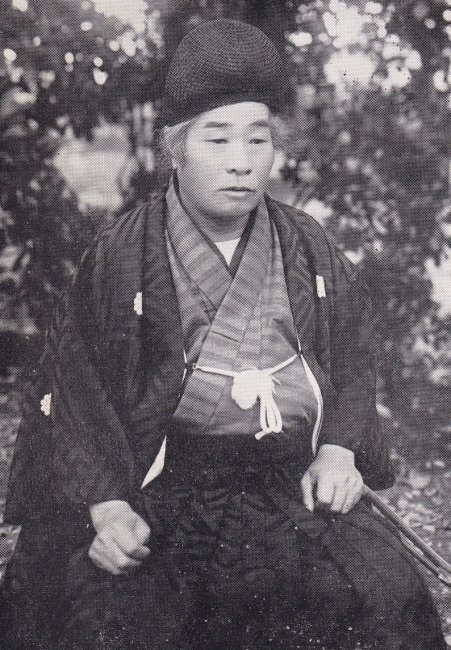
Onisaburo wearing Omoto missionary robe and headgear in Taisho 14 (1925).
For your reference: The Omoto Missionary Chant
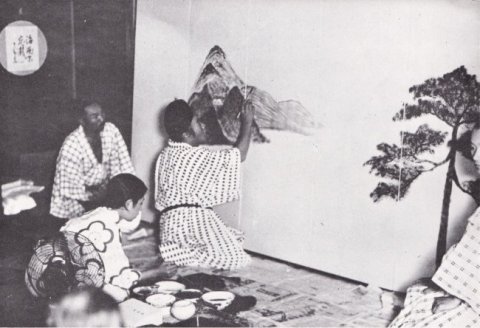
Onisaburo drawing a picture on a folding screen in Showa 7 (1932)
The year 2025 marks the 101st anniversary of Onisaburo's mission in Mongolia.
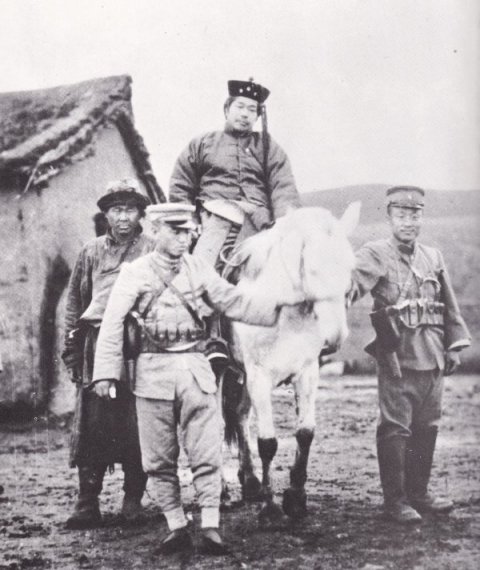 Onisaburo and his party in Mongolia in Taisho 13 (1924) 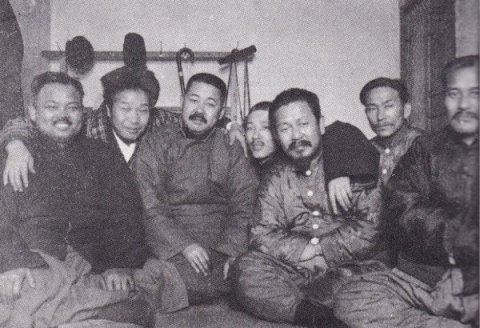 Onisaburo (2nd from left) and Ueshiba, founder of Aikido (far right), in Taisho 13 (1924)
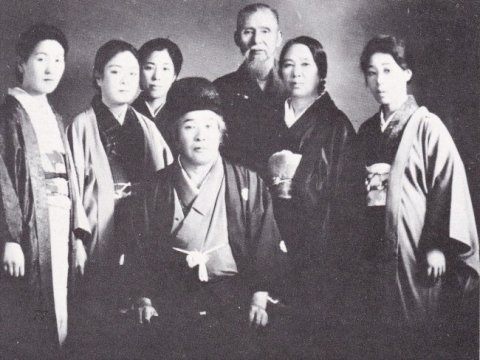
Onisaburo surrounded by his scribes of the Reikai Monogatari in Showa 8 (1933)
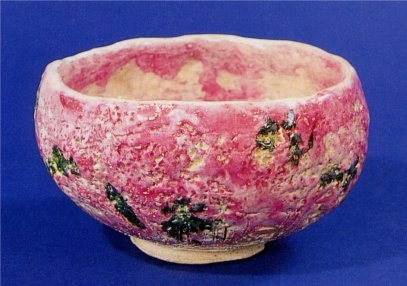
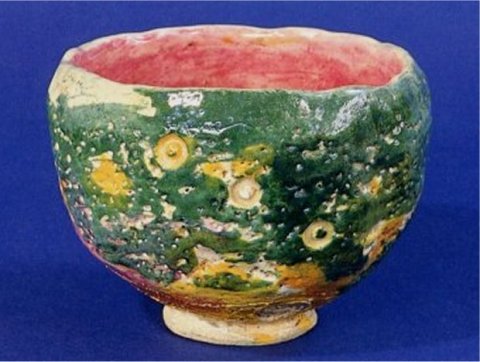
Onisaburo's handmade yowan (scintillating tea bowl) 'Shangri-La'
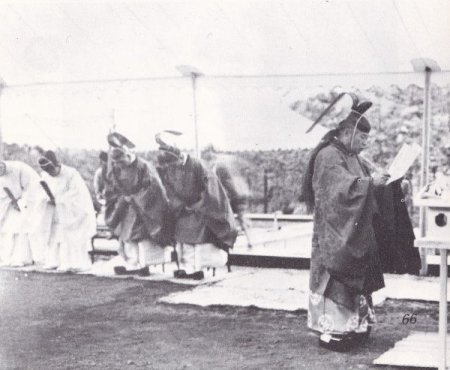
On Decemeber 8, Showa 20 (1945), Onisaburo and his followers performed a religious ceremony to report the resolution of the Second Omoto Incident to the Kami (see image below).
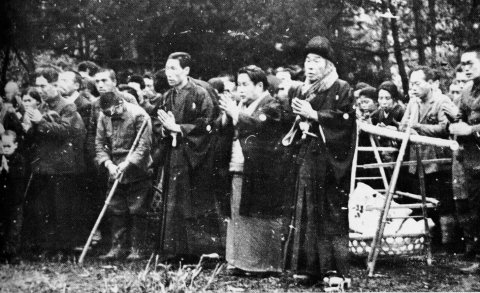 (Front right through left) Onisaburo, Sumi, and Uchimaru offering norito prayers to the Kami atop Mount Hongu in Omoto's holy sanctuary in Ayabe, Kyoto.
December 8 is also the date when the Second Omoto Incident broke out in Showa 10 (1935) or when Japanese forces attacked on Pearl Harbor to wage war with the United States in Showa 16 (1941).
Japanese Buddhism considers December 8 a sacred date because it was when Siddhartha Gautama attained enlightenment to become the Buddha.
From this date on, Onisaburo started a new religious group named the Aizen-en (literally "Garden of Love and Goodness") by totally renewing the outdated Omoto religion to create good kata models for Japan and the world in the future.
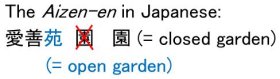
Onisaburo avoided using the box-like kanji character
to make his new religious group open to anyone.
It is important to note that Onisaburo cast away the old Omoto organizaion and started anew with the establishment of the novel Aizen-en. In other words, he had no intention of reverting his brand-new Aizen-en to the old Omoto.
As head of the Aizen-en, Onisaburo set two major policies for the religious group:
- The spirit of aizen ("love and goodness" or "universal love and brotherhood"), and
- The oneness of all good religions (bankyoh dohkon)
For the first policy, Onisaburo says something to the effect that all good faiths preach love as the warp and goodness as the weft, and that the term "aizen" is like the essence of any good faith.
Onisaburo Onisaburo mingling and talking with young believers in 1932.
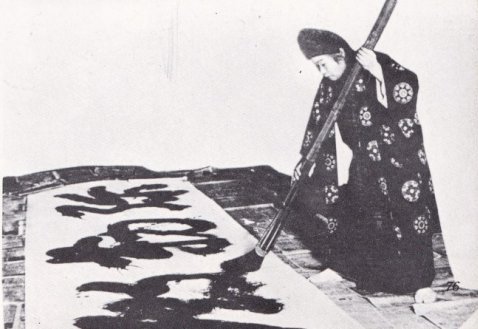
Onisaburo writing calligraphy with an 8 ft long brush. (March 18, 1930)
Onisaburo's handmade yowan (scintillating tea bowl) 'Orion's Belt'
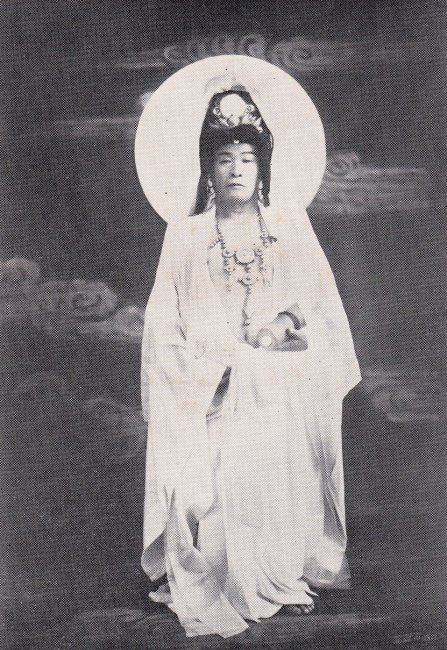
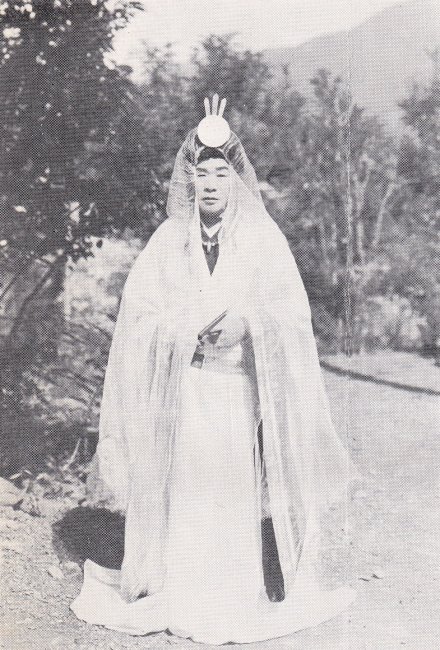
Onisaburo disguising himself as Avalokitesvara, the Bodhisattva of Compassion. (October 22, 1933)
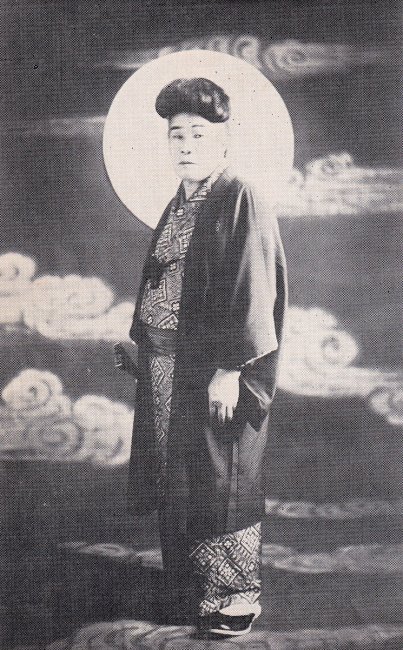
Onisaburo posing for a photo. (October 22, 1933)
Onisaburo clad in a kimono with Omoto's 'Divine Ten-Luminary' crests.
(November 1933)
 The Divine Toyoh (Ten-Luminary or Ten-Sphere) Crest
Onisaburo disguised himself as the Great Kami Kamususanowo, the ultimate protagonist in the Reikai Monogatari, who leads his kototama squads to slay the Great Black Master, the ultimate evil antagonist in the present-day Indian City of Mumbai. (October 12, 1933)
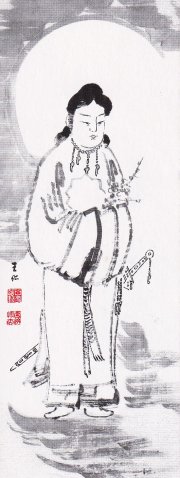
Incidentally, Onisaburo made India ink paintings of the Great Kami Kamususanowo and Kunitokotachi no Mikoto, as shown below:
 |
|
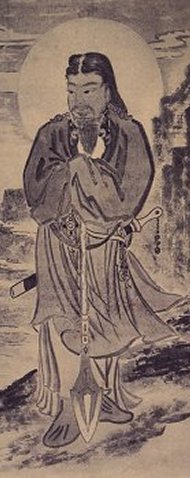 |
| The Great Kami Kamususanowo (right) working in tandem with Kunitokotachi no Mikoto (left) dubbed "Ushitora no Konjin." |
Onisaburo was one of the first persons to advocate the oneness of all good religions, and launched missionary efforts around the globe:
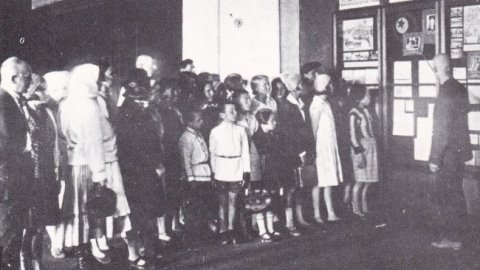 An exhibition of Omoto's activities at a museum in Kyiv, Ukraine in 1932 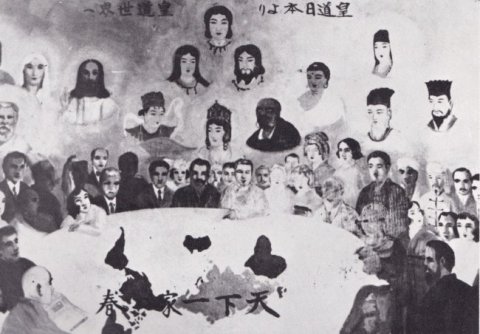 An Omoto exhibit showing oneness of major world religions at the Great Religious Exposition in Kyoto, Japan in 1930
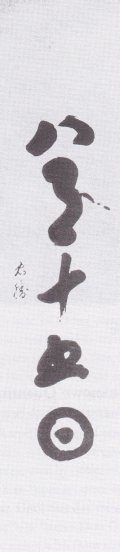
The following is Onisaburo's calligraphy "August 15."
August 15 marks the anniversary of Japan's surrender in WWII.
Onisaburo had long prophesied Japan's defeat in the war, suggesting that reforms of Japan were part of the Kami's grand design.
In 1943, Onisaburo gave soldiers leaving for the front some special amulets on which he wrote the words "Victory to the Enemy."
August 15, also marking the "Day of the Harvest Moon" in the lunar calendar, is a symbolic date for Onisaburo because of his association with the Moon.
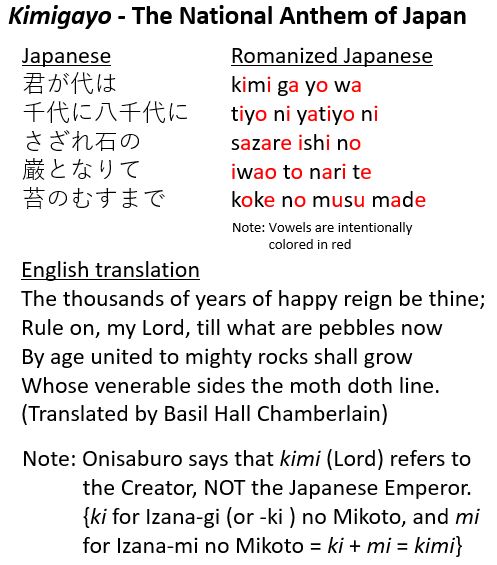
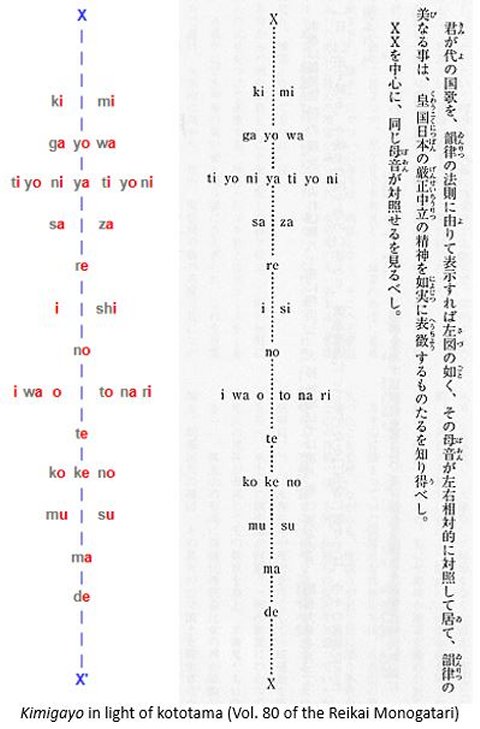
Onisaburo claims that the vowels in the lyrics of Kimigayo, the National Anthem of Japan, are arranged symmetrically along the X - X' line, suggesting the country's inherent commitment to the spirit of neutrality. (See images for details)
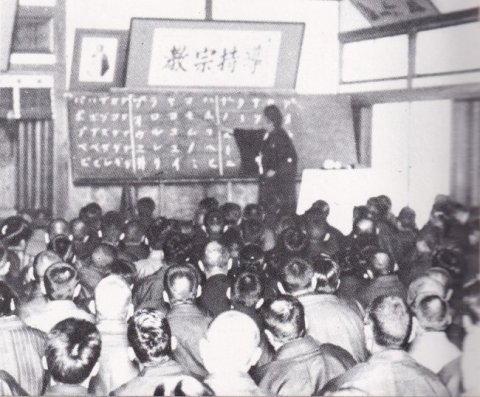
Onisaburo giving a lecture on the study of kototama (literally, the spirits residing in words), i.e. the belief in the magical power of Japanese words and syllables, at Omoto's Taishoden Hall in Kameoka, Kyoto in 1933.
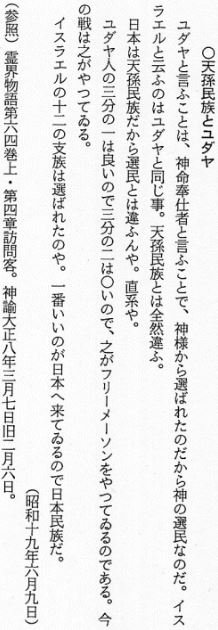
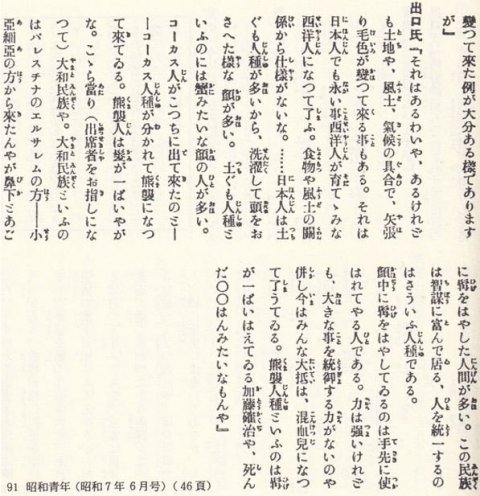
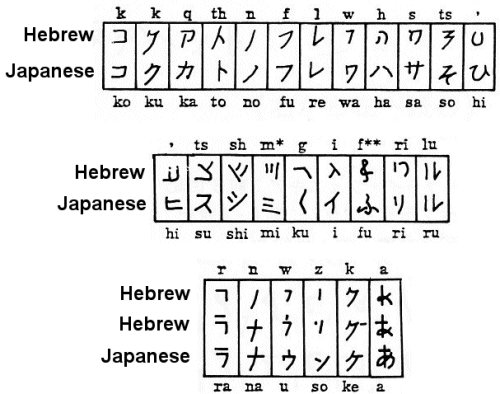
Onisaburo says that some lost tribes of Israel came to ancient Japan, laying the foundation for the Yamato race, the dominant Japanese population. (See below)
Joseph Eidelberg, the author of The Japanese and the Ten Lost Tribes of Israel, supports this possibility. He points out striking similarities between the Hebrew alphabet and the Japanese kana syllabaries, as shown below:
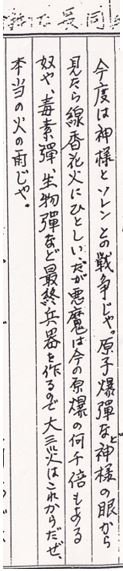
The following are excerpts from what Onisaburo revealed about the future of Japan and the world in post-WWII eras during his stay at a hot springs resort in Yoshioka, Tottori Prefecture from December 10, Showa 20 (1945) to January 6, Showa 21 (1946).
The English translation of the above:
"Next will come the Kami's war with the Soviet Union. In the eyes of the Kami, atomic bombs are nothing more than sparklers. But devils will create bombs thousands of times more powerful than the current atomic bombs, poison bombs, biological bombs, and other ultimate weapons. The three great calamities, i.e. fire, water and wind disasters, will unfold in the future. That is when a true rain of fire will fall."
For details, see Onisaburo's Revelations at the Yoshioka Hot Springs
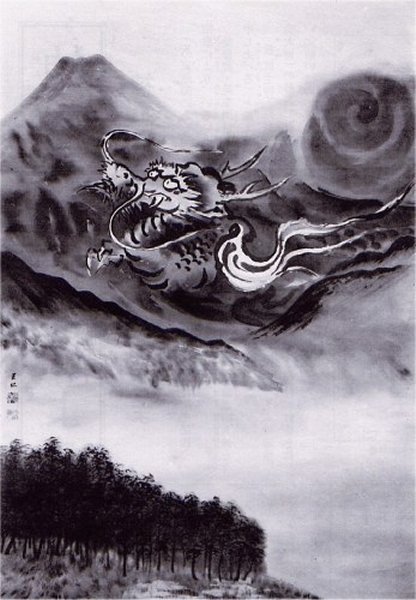
An India ink painting An Ascending Dragon by Onisaburo
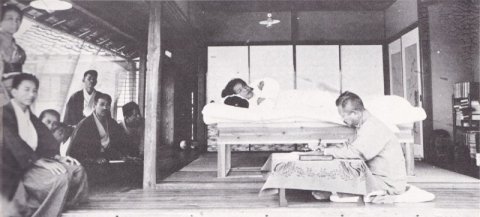
Onisaburo lying in bed to dicate the Reikai Monogatari to a scribe in 1925.
(Average speed: Only three days per 300-page volume!)
The 81-volume Reikai Monogatari is available for free download at the Aizen-en.
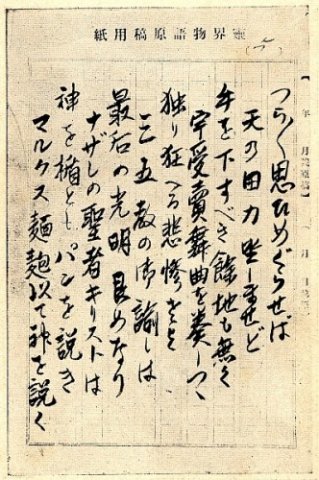 A manuscript of the Reikai Monogatari
Onisaburo chanting the Amatsu Norito prayer as presiding priest on Mount Hongu in Ayabe, Kyoto in Showa 10 (1935)
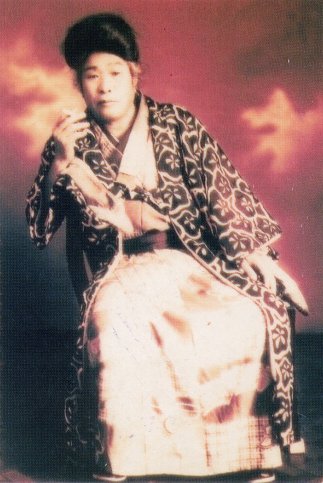
Onisaburo Deguchi (1871-1948)
His favorite cigarette brand was Shikishima, which was on the market between 1904 and 1943.
Incidentally, Shikishima is a poetic and historical name for Japan.
|
|
|